


| Motormounts - Clusters |

|

|
Composition - Clusters - Multistage
2 Cluster - 3 Cluster radial - 3 Cluster inline - 4 Cluster - 11 Cluster
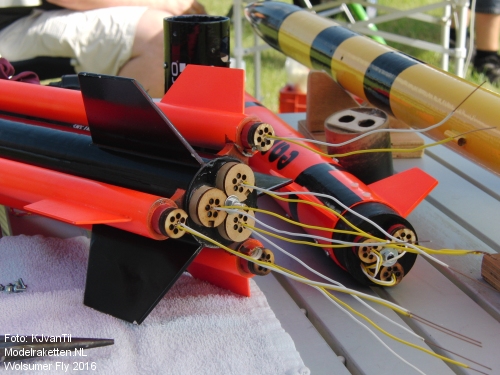
| Clustering model rocket engines means that you ignite several engines at the same time: they sit next to each other, they are clustered. You can thus increase the carrying capacity of your rocket: increase the amount of take-off weight. It is also possible to do the same with several lighter engines than with one heavy engine. |
|
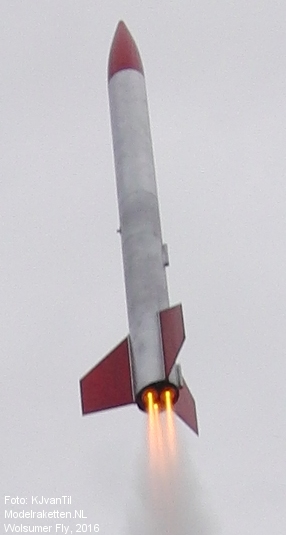
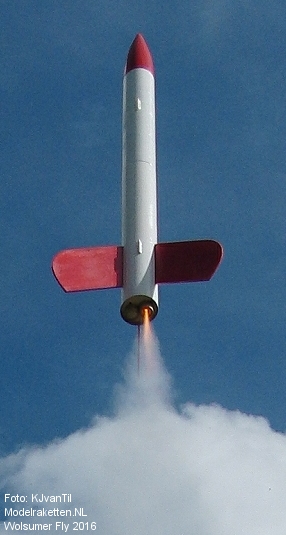
Clustering does result in some problems with the proper ignition of all those motors. Because everything has to ignite exactly at the same time. If the model is already gaining altitude and a motor is not yet ignited, then the igniter will probably be pulled out and the motor will not ignite. The result is that you lose a part of your load capacity and your model gains less peak altitude. This can cause problems for a good recovery phase. The good and simultaneous igniting of a cluster is really always a lot harder than a rocket with one motor. Yet it must be possible, of course, a nice challenge! The Estes motors are slightly easier to start than the Klima's. They are black powder motors. The Klima's are composite or white powder motors. They especially need a lot of pressure when burning. In the beginning the pressure is not or less present and therefore it is more difficult to start. Very important is a good voltage on your launcher and fresh batteries that can provide a lot of power. (preferably 12V, sealed lead-accu, but with less is also possible) Not all batteries are capable of this. The rechargeable batteries can often do better than ordinary penlites. Especially if you use Lipos or NiMh. |
| Cluster of 3 motors, succesfulll started | Cluster of 2 motors, only 1 started |
 |
 |
| Before you launch a model, you can of course do a test or several, with the igniters and whether that works. It will cost you two or more igniters, but you save a rocket ... Connect the igniters parallel to each other of course, pay attention! (although this can also be done serially with bridge igniters and a good battery ...) The preparation and installation of the motors and the electric igniters requires considerably more time and care than when a model rocket is launched with a single motor. |
| Some examples |
||
|---|---|---|
|
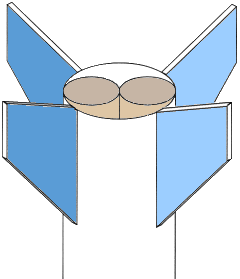
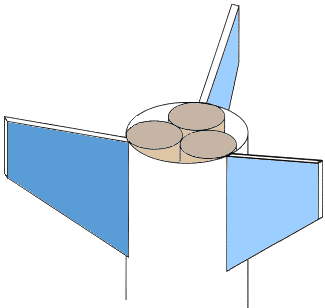
Cluster 2 Placing a cluster of 2 motors in a model rocket. Of course, the space between the motor mounts and the body tube must be closed. Otherwise the overpressure of the ejection charge will be lost through these openings and the recovery system will not be blown out of the model. Here you make centering rings with two holes in it, one for each motor tube. |
|
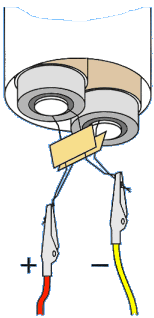
Connecting Starters With a cluster of two motors, the igniter wires can easily be twisted together. Please note that you hold the wires well while doing so, otherwise the head with igniter material may break. |
|

|
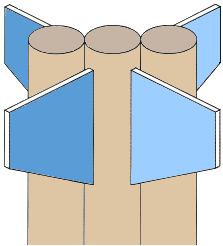
Cluster 3 radial Placing a cluster of 3 motors in a model rocket. In the drawing opposite, the motors are arranged radially with respect to the central vertical axis of the model. This is the most ideal arrangement of the motors because they are all placed as close as possible to the central axis. |
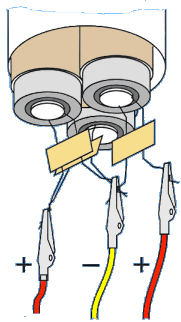
| Connecting Starters When connecting a cluster of three motors who are arranged radially, you can use an extra plus clip. |
|
|
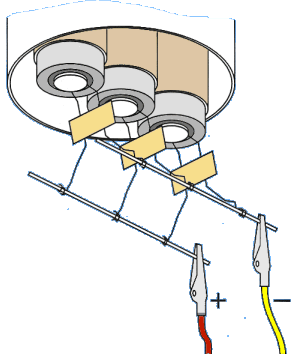
Cluster 3 in-line Het plaatsen van een cluster van 3 motoren in een modelraket. Op de tekening hiernaast zijn de motoren ten opzichte van elkaar 'In-Line' opgesteld. Dit is een iets minder ideale opstelling dan een cluster van 3 radiaal. De centrale verticale as van het model bevindt zich in het midden van de middelste motor. De andere twee motoren bevinden zich net iets verder vanaf die as dan wanneer de radiale opsteling wordt gebruikt. Het nadeel hiervan is dat wanneer één van de twee buitenste motoren niet ontbrandt, er een momentum ontstaat, ten opzichte van de centrale as, door de wel werkende motor. Dit effect is bij radiaal geplaatste motoren iets minder, omdat de afstand van de motoren ten opzichte van de centrale as iets kleiner is. Door dit momentum kan je model meteen na de start een 'kromme' baan gaan beschrijven, wat natuurlijk niet gewenst is. Dit kun je weer tegengaan, door je model lichtjes te laten roteren om zijn lengte-as, tijdens de vlucht. |
| Connecting Starters Als de motoren ver uiteen liggen kan gebruik worden gemaakt van een plus en een min hoofddraad. Let wel op een goed contact. Omdat het niet ontbranden van één van de buitenste motoren een groter negatief effect heeft dan bij de radiale opstelling, is hier een zorgzame voorbereiding van nog groter belang. |
 |
|
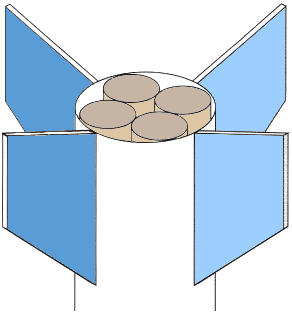
Cluster 4 Bij een cluster van 4, zijn de motoren ook radiaal opgesteld ten opzichte van de verticale hoofdas. Een 'In Line' opstelling zou ook kunnen, maar is verre van ideaal. Reden hiervoor is dat de twee buitenste motoren ver van de centrale verticale as van het model verwijderd zijn. Het momentum bij het niet ontbranden van één van deze motoren zal te groot worden om een goede vlucht mogelijk te maken. |
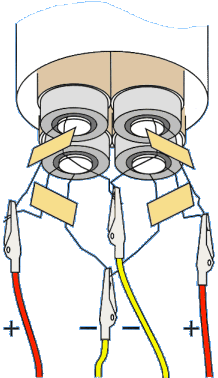
| Connecting Starters Aansluiten van een cluster van 4. Let op de twee extra clips. Hier kun je twee plus- en twee mindraden gebruiken. De rechterkant van iedere ontbrander kun je verbinden met de linkerkant van de ernaast gelegen ontbrander, totdat je het kringetje rond bent. Draai de draden in elkaar, zodat er goed contact ontstaat. |
|
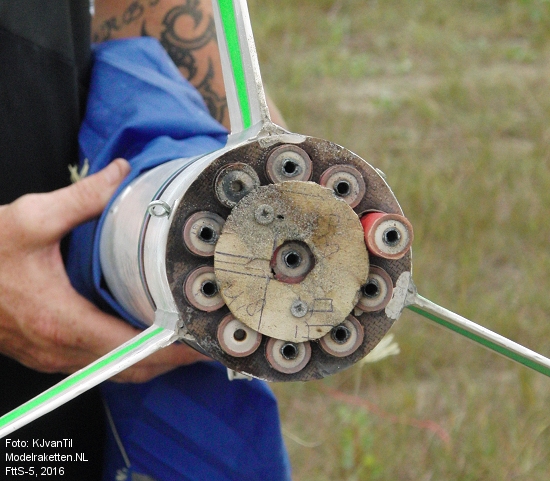
| Clustering can, of course, be more extreme also and a greater challenge. Below is an 11-cluster with 18mm engines. At the first two starts, all engines failed to ignite. But, 9 out of 11 is not bad either ... |

|

|
|

|
|||
| Modelraketten.NL © 2026 KvK-Nr: 50001574 BTW-ID: NL001590630B51 | ||||||